

Nitrous Oxide Sedation
What is nitrous oxide?
Nitrous oxide, N₂O, is a colorless, odorless gas with a slightly sweet taste. In medicine, nitrous oxide is used as an analgesic gas for anesthesia or as a nitrous oxide-oxygen mixture for pain management during short, moderately painful surgical procedures. Nitrous oxide is rapidly absorbed by the body but is not metabolized. Therefore, no nitrous oxide remains in the body after treatment.
The use of nitrous oxide has long been considered a safe and recommended sedative for anxious patients, children, and patients with difficulty swallowing or a gag reflex.
Who is nitrous oxide suitable for?
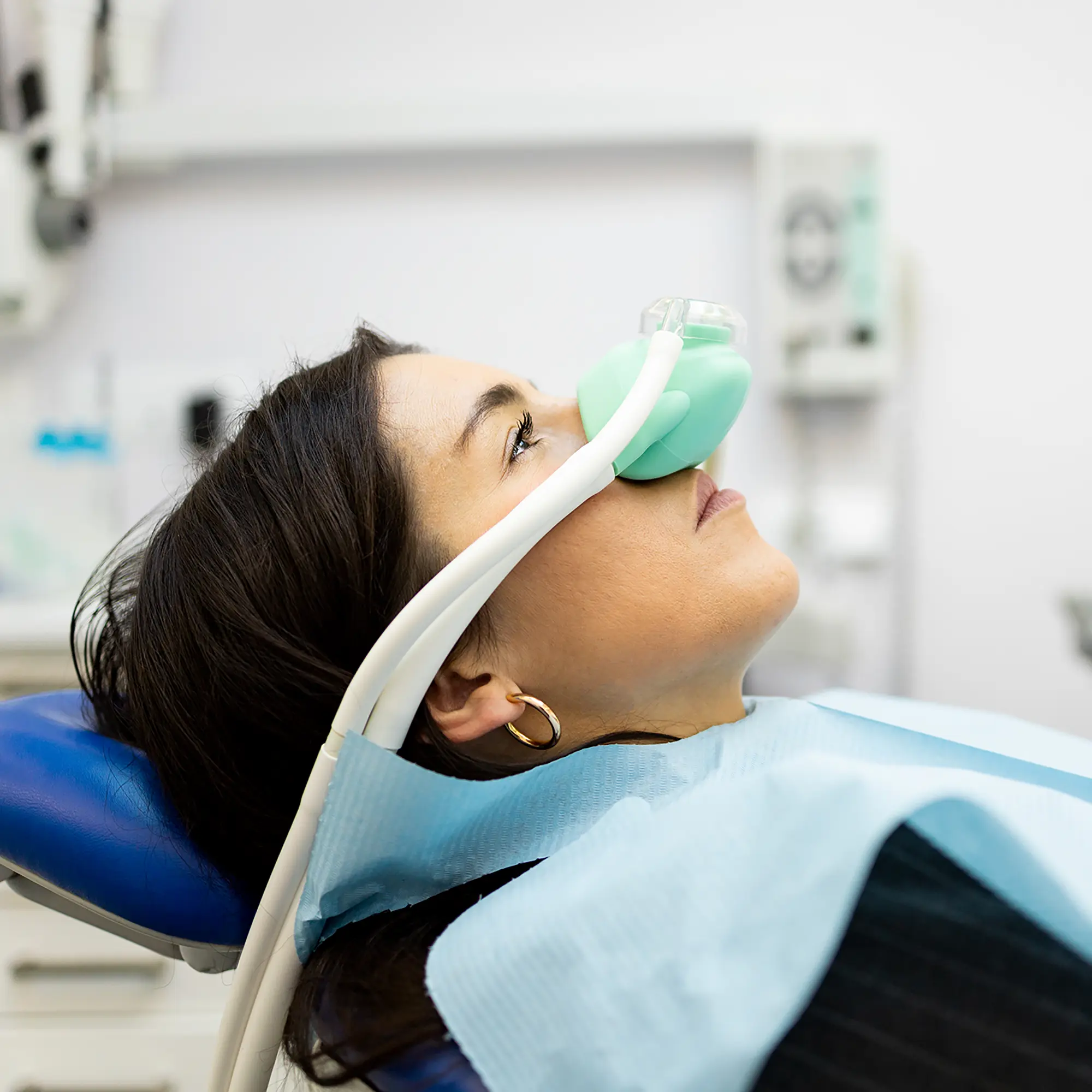
Nitrous oxide is suitable for almost all patients who experience anxiety during medical visits. Anxious patients and children ages 4 and older benefit from this safe method. For children, a certain level of maturity is required for treatment, as the child must breathe in and out through the nose for an extended period of time.
Nitrous oxide is particularly beneficial for patients who experience an above-average swallowing and gag reflex. This reflex is suppressed by the gas mixture.
However, in the following cases, dentists must weigh the potential risks and tailor the treatment to their patients:
-
Chronic Obstruktive Pulmonary Disease (COPD)
-
Severe mental and behavioral disorder
-
Refusal to Cooperate in Cases of Severe Disability
-
Pregnancy (first trimester)
-
A recent or current middle ear infection
-
Eye surgery that has already been performed or is scheduled
-
(Severe) cold symptoms—when is it appropriate to use nitrous oxide?
Is nitrous oxide safe?
To ensure successful treatment, some children need to be sedated. Nitrous oxide is the safest and most effective form of sedation for alleviating a child’s anxiety and ensuring a positive experience. U.S. studies show that 90 percent of American pediatric dentists use nitrous oxide on a daily basis.
Gentle sedation is ideal for young patients. For them, the treatment goes by in a flash, and thanks to the sedation, the dentist can focus on doing his or her job. A visit to the dentist thus becomes a positive experience—completely free of fear.
-
Is nitrous oxide sedation harmful to my body?
No, nitrous oxide sedation is not harmful to the body and has virtually no side effects. Nitrous oxide has long been one of the safest, most extensively studied, and oldest sedatives. In many other countries, millions of patients have been successfully sedated with nitrous oxide every day for years.
-
How does nitrous oxide sedation affect the brain?
Anesthetic agents used in medicine act on the central nervous system—that is, on the brain and spinal cord. As soon as they take effect, the sedative suppresses our consciousness and desensitizes us to pain. Nitrous oxide prevents nerves from communicating with one another. In this way, no pain signals are transmitted from the surgical site, where the surgeon is working, to the patient’s brain.
Nerves communicate by releasing chemical signals, which are then picked up by neighboring nerves. -
Can I drive on my own after receiving nitrous oxide?
Yes, just 15 minutes after the treatment, the nitrous oxide has been exhaled and the patient is once again fit to drive.
-
Do I need to fast before nitrous oxide sedation?
No, it is not necessary to be fasting before a nitrous oxide treatment. The patient's daily routine is not affected, and patients can eat and drink as usual.
-
How does nitrous oxide work?
Nitrous oxide transforms patients’ anxiety—which they feel before treatment—into a state of deep relaxation. Inhaling nitrous oxide induces a sense of inner calm, minimizes pain perception as well as the urge to swallow and gag, and triggers a soothing feeling of security. This safe and highly effective method of patient sedation has already helped millions of people overcome their fear of dental treatment and is part of routine dental care in many countries.
The concentration of nitrous oxide is increased very slowly using a regulator and adjusted individually so that patients are in an optimal state of sedation.
Nitrous oxide takes effect within just a few minutes and suppresses anxiety before it can even arise. Unlike general anesthesia, patients remain fully conscious and responsive throughout the entire treatment.
Patients who have been treated with nitrous oxide report a warm and pleasant sensation.
The duration of nitrous oxide’s effects is limited to the duration of sedation. Because the gas is administered and withdrawn rapidly, it takes effect and wears off quickly in the body. The analgesic effects occur at a concentration of 20% nitrous oxide in the inhaled air; for a narcotic effect, the concentration can rise to between 40 and 70 percent. After sedation ends, the nitrous oxide clears from the body within 2 minutes and therefore has no aftereffects.
-
What are the benefits of nitrous oxide sedation?
Nitrous oxide sedation offers many benefits for patients, including a very rapid onset of action and a very quick return to normal motor function and the ability to drive, which means no companion is needed on the day of treatment. Furthermore, the sedative reduces anxiety, enhances patients’ sense of well-being, and helps them disconnect from the treatment. Because it is a gentle and mild sedative, it causes few side effects.
Another primary advantage is that, because it is administered safely by the dentist, an anesthesiologist is not required.
Does nitrous oxide cause pain?
No, nitrous oxide has long been used in medicine as an alternative to general anesthesia. Nitrous oxide has analgesic, anxiolytic, and calming effects.
-
Does nitrous oxide have side effects at the dentist's office?
The few side effects associated with nitrous oxide include nausea, dizziness, vomiting, increased sweating, and restlessness.
In most cases, these side effects result from administering too high a dose of nitrous oxide or administering it too quickly. These side effects can be prevented by adjusting the nitrous oxide-oxygen mixture to the patient’s needs.
Rare side effects also include psychomotor side effects—which resolve within 15 minutes—and psychiatric side effects, such as dreams and euphoria.
Other possible side effects include:
Cardiovascular side effects:
- No relevant side effects when used alone
- Slight decrease in heart rate
- Slight decrease in stroke volume
Respiratory side effects:
- Minimal or no respiratory depression
- If the effect is insufficient, consider another form of anesthesia
Impact on vitamin B12 synthesis, particularly in vegans and vegetarians
Symptoms such as tunnel vision, ringing in the ears
According to a survey by the German Association of Pediatric Dentists, nitrous oxide sedation has fewer side effects than local anesthesia.
-
Does nitrous oxide cause pain?
No, in medicine, nitrous oxide has long been used as an alternative to general anesthesia. Nitrous oxide has analgesic, anxiolytic, and sedative effects.
-
How much does nitrous oxide sedation cost?
Since it is a simple sedation technique, nitrous oxide is less expensive than general anesthesia. The cost is €150 per hour, depending on the duration of sedation. Nitrous oxide is particularly suitable for shorter appointments, as it takes effect quickly and wears off just as quickly.
-
Does health insurance cover nitrous oxide treatment?
Unfortunately, nitrous oxide sedation is not covered by public health insurance. The fee will therefore be billed directly by your dentist. Supplemental dental insurance may help reduce your out-of-pocket costs. Whether private health insurance covers these costs depends on your specific plan and the benefits it provides.
-
Do you have to laugh when using nitrous oxide?
This is not usually the case, but it can happen. Among other things, the gas stimulates the diaphragm, which can cause laughter. If this occurs, the effect lasts only a short time and is limited to the beginning of sedation.
In its pure form, nitrous oxide is also used as a drug; within a few seconds, it induces a high characterized by mild hallucinations and feelings of warmth and euphoria. Here, too, the diaphragm is stimulated, which can lead to uncontrollable laughter. However, this is not without risk; the Federal Center for Health Education warns that it can damage internal organs and the nervous system.
During nitrous oxide sedation, pure nitrous oxide is not used; instead, an oxygen-nitrous oxide mixture is administered, ensuring that the patient receives an optimal supply of oxygen throughout the entire treatment.
Each patient’s experience with nitrous oxide at the dentist’s office is unique. -
How does nitrous oxide affect people with asthma?
“Bronchial asthma” is one of the most common chronic respiratory diseases.
During nitrous oxide sedation, neither breathing nor the cardiovascular system is affected in healthy patients. Asthmatics, in particular, find nitrous oxide treatment pleasant, as it delivers more oxygen than is present in the air. -
How much does nitrous oxide numb you?
Nitrous oxide induces a relaxed state and has a sedative effect on the body, thereby alleviating mild pain such as the prick of a needle.
Sedation with nitrous oxide may or must be combined with local anesthesia for more complex treatments. For more extensive procedures, nitrous oxide alone is not sufficient to completely eliminate pain. -
Is nitrous oxide a general anesthetic?
No, nitrous oxide is not a general anesthetic. During treatment with nitrous oxide, patients remain fully conscious. This has the advantage that the dentist can talk to his or her patients.
How does nitrous oxide sedation work?
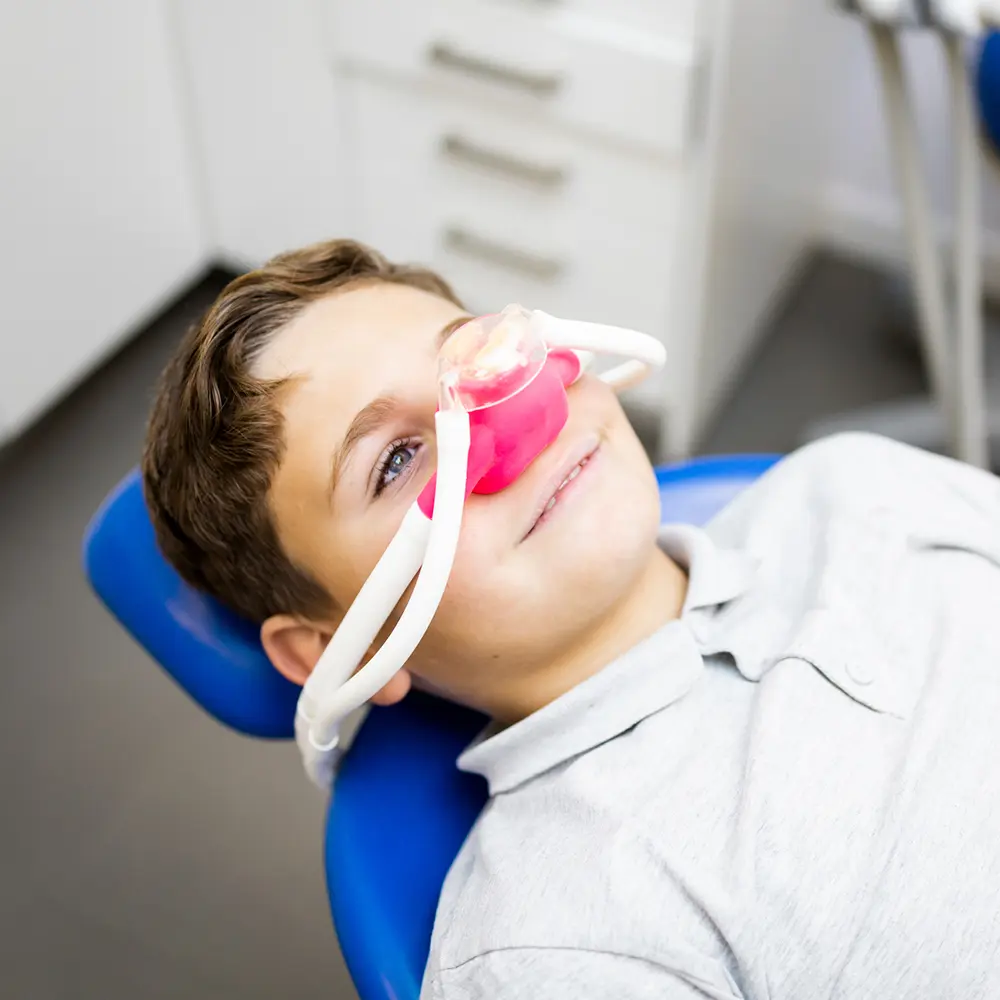
The face mask:
Before treatment begins, the patient is given a nasal mask to put on. The nitrous oxide-oxygen mixture is delivered through the nasal mask. The patient breathes in and out through the nose.
To ensure an even more comfortable experience during treatment, we at Baldus Sedation have developed a new nasal mask product: scented disposable double-layer nasal masks. Patients can choose their favorite scent from six different options.
Baldus disposable double-nose masks with fragrance ensure greater comfort for the patient thanks to their perfect fit, reduce airborne contamination, and, thanks to their flat shape, provide the dentist with more space to work.
Thanks to the soft, snug-fitting inner mask and the transparent outer mask, which fits more closely to the face, the patient’s breathing can be monitored, providing additional safety for the practitioner.
Baldus Sedation products offer greater reliability, protection, and comfort.
The Scavenger System:
The scavenger system is a medical device used to maintain the patient's respiratory circuit during treatment. The patient inhales the oxygen-nitrous oxide mixture through the scavenger system and exhales it back through the tubing set. Its basic function is to serve as a tubing system for conveying gases.
Inhalation phase:
The oxygen-nitrous oxide mixture is delivered through the tubing system and inhaled through the nasal mask.
Exhalation phase:
When the patient exhales into the inner mask, a membrane opens and the exhaled gas enters the outer mask. The suction system in the outer mask is separate from that in the inner mask, allowing the patient to inhale without any additional resistance.
The exhaled gas is optimally directed into the vacuum channel via the oval membrane and the aerodynamic guide channels.
The dual-nose-mask system effectively protects staff from exhaled gas. The flexible, autoclavable nose masks are easy to replace and are available for both adults and children.